In many ways, “know your audience” is the comms world’s version of “profit = revenue - cost.” So simplistic it makes your teeth hurt, yet overlooked with such frequency that it bears repeating ad nauseum.
To be fair, few people in any line of work would argue that knowing their audience doesn’tmatter. They just don’t know what they don’t know, or they put too much faith in what they think they know. In any case, it’s common to see two main types of mistakes:
These are caricatures of extreme positions. But if you consider them as endpoints on a spectrum, you’ll find that most organizations struggling to attract attention gravitate toward one or the other. Their comms strategy is either guided by a leader’s idiosyncrasies, or a hodgepodge of reports and analytics dashboards that point in several directions at once.
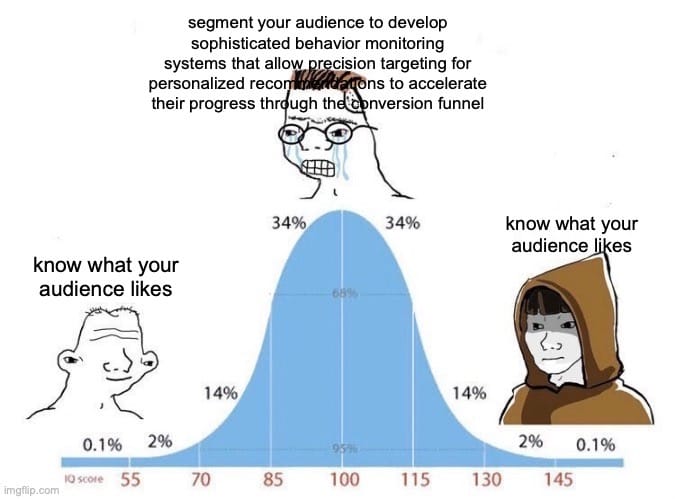
“Knowing your audience” in 2026 requires both instinct and data. What’s tricky, though, is that there’s no universally applicable formula for how to weigh each of those inputs.
For example: if you’re the founder of a pet supplies company who’s spent decades immersed in the minutiae of the cat-lovers’ community, you don’t need a Sankey diagram to understand their monthly budget allocation for wet food vs. crinkly bags vs. litterbox sand.
It might be useful, though, to have numbers on what toys sell best in summer before sending your next newsletter. Basic stuff, but enough to orient your comms in a fruitful direction.
Sometimes knowing your audience—or at least, communicating in ways that give the impression you do—requires a pint of art and a tablespoon of science. Other times it requires the opposite; the proportions can also be completely different. But there’s always a blend of both.
Here are three organizations, catering to very different audiences, who found the right mix for them:

Audience: Intellectually curious generalists with a taste for weird tidbits of science knowledge that make good conversation fodder at cocktail parties
How this caters to them: Nobody reads Popular Science’s newsletter for dense academic discussions of cross-phyllum gut biomes. But put a quirky anecdote spin on it…
Art-science-blend takeaway: This article from August 2024 appeared in a July 2026 newsletter. PopSci’s page view data must support what intelligent observers have always suspected: animal farts get clicks.

Audience: Girls who were dorks in high school, then briefly cool, and now just middle aged
How this caters to them: A contemplation of video games, gender identity, and problematic politics whets every appetite developed during one’s journey through the nerd-hipster-parent cycle
Art-science-blend takeaway: Paradox Games has over 5 million monthly users—and many who aren’t angry young fascists want to read stories that assure them they have respectable company in enjoying these games

Audience: Sports fans who are also interested, to lesser but not insignificant extents, in popular culture and the forces shaping it
How this caters to them: Want to know the deal with SpaceX’s news-dominating IPO without having to read a breathless business outlet like The Wall Street Journal? Here you go—it’s funny, too.
Art-science-blend takeaway: In late June, Elon Musk’s quest to become a trillionaire received approximately 7.2 quadrillion units of attention across all media platforms. Might as well capture a few of those for your own advertisers (by mocking him).
In terms of target demographics, content subjects, artistic direction, and almost any other characteristic you can name, these outlets have little in common. But they all know what their particular audience is hungry for, and they serve that up on a plate consistently.
They’ve all mastered the art of getting attention:
Because the last word is rarely the end of the conversation.
Much like penguins, we enjoy bringing you little gifts to show we care:
If you only click on one novelty website today featuring statistics that will scorch your corneas, make it Is AI Profitable Yet?
The Future Society is hiring a Communications Coordinator based anywhere in the world—up to $92k a year, with 30 days of annual leave and a robust benefits package.
Good news for fans of pint-sized cephalopods: a new species of tiny octopus was just discovered in the Galápagos islands.